Plan for the habitat you are entering
Before visiting, check the relevant protected-area authority, land manager or local municipality for access information. A route open in one season may be closed during breeding. Landing, boating, dog access, drones and shore walking can each have different restrictions. A general travel description or an old photograph is not evidence of current permission.
Geirangerfjord and Nærøyfjord form the West Norwegian Fjords World Heritage property, while other fjords have different designations or none. A conservation label does not make all activities acceptable, and the absence of a label does not remove wildlife protection duties. Look for the actual rules applying to your intended place and activity.
Give animals control of the encounter
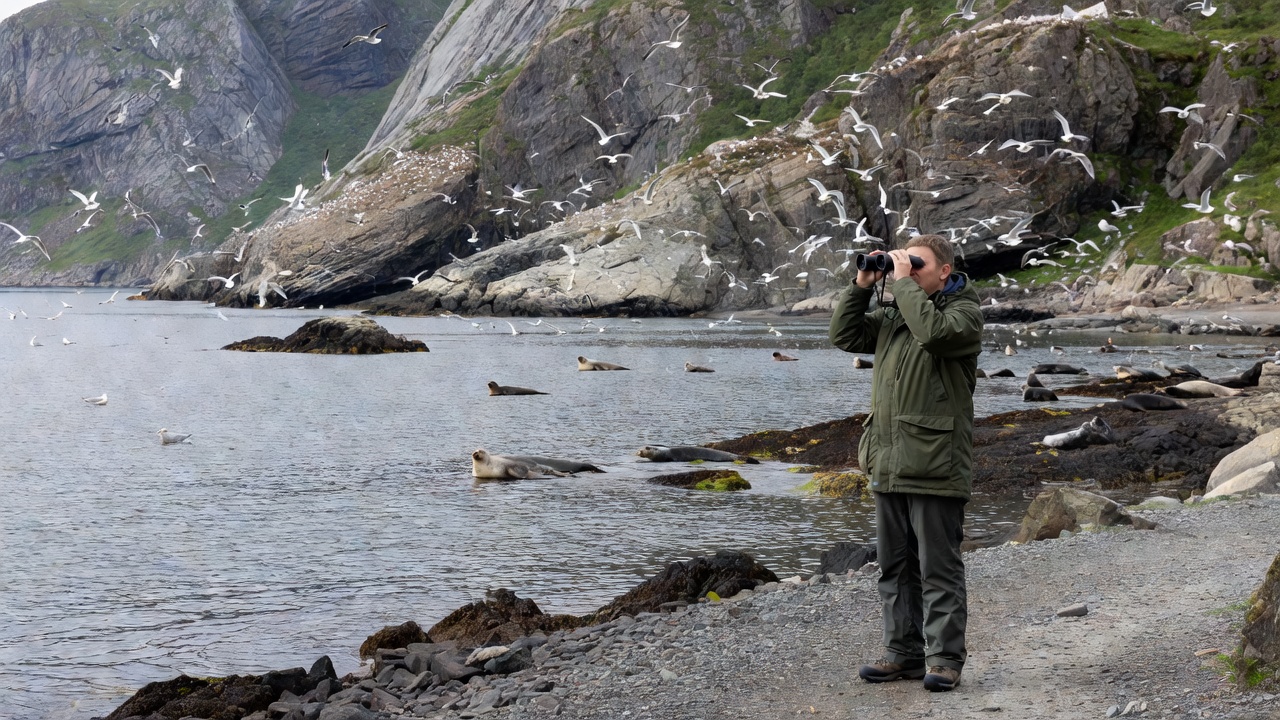
Choose a viewpoint outside an animal’s route between water, resting ground and feeding area. Stay together rather than spreading around a group. Avoid positioning yourself between an adult and its young, or between a seal and the sea. A clear escape route matters, but your aim should be to avoid creating a need to escape.
Watch for changes in posture, attention, calling, movement or group spacing. Repeated head lifting, alarm calls and animals moving away can indicate disturbance. They are not the only signs, and an animal that freezes or remains in place may still be affected. Increase distance early; do not wait for a dramatic flight response.
A distance rule that travels
Follow the local legal minimum, then add more space whenever conditions or animal behaviour require it. A minimum is not a viewing target.
On the water, avoid adding pressure
Small boats and kayaks can disturb animals as well as larger vessels. Quiet movement is not automatically low-impact if it brings a person too close to a resting or nesting site. Never pursue an animal, cut across its route or surround it with other craft. Follow local operational guidance and maintain a predictable, non-intercepting course.
Choose operators who can explain how they respond to wildlife, other vessels and changing conditions. Ask whether they respect closures, avoid feeding and playback, and leave encounters when animals show disturbance. A responsible trip may finish without a close view. Sighting guarantees and pressure for dramatic photographs are poor foundations for wildlife observation.
Protect more than the visible animal
Shoreline vegetation, kelp, burrows and intertidal surfaces can be damaged even when no large animal is present. Stay on permitted durable routes and avoid creating new paths around a viewpoint. Keep dogs away from sensitive wildlife and follow local leash requirements. Do not move rocks, collect living material or feed wildlife to improve an encounter.
Take your litter home and secure loose items before reaching exposed shorelines. Remove safe, accessible litter only when doing so will not damage habitat or put you at risk. Entangled animals, suspicious containers, sharp objects and fishing gear under tension require appropriate advice. Do not turn a cleanup into an improvised wildlife rescue.
Separate an observation from an emergency
A seal resting alone, a bird sitting still or a whale remaining in an area is not automatically in distress. Look for clear information you can report without approaching: visible injury, entanglement, unusual stranding position or an immediate human-caused threat. Note the general situation and contact the relevant local wildlife response service or authority.
Do not push a stranded cetacean back to sea, pull on entangling line or handle a bird without instructions. Such actions can injure you or the animal and may be unlawful. This website is not monitored as an emergency service. Use official local response channels and emergency services where there is an immediate danger to people.
Share knowledge without directing a crowd
A photograph can expose more than the subject. Embedded coordinates, recognizable access points and real-time captions can draw visitors to a nest, haul-out or feeding group. Consider sharing a broad region and a habitat explanation instead. Delay publication when immediate attention could add pressure, and remove precise metadata where appropriate.
Scientific reporting can require more precise information, but that does not mean the record should be public. Use established schemes with sensitive-species safeguards and follow their submission guidance. Record identification uncertainty and distinguish direct observations from interpretations. Ten careful notes are more useful than ten confident claims built on the same unclear view.
Connect everyday choices with wider pressures
Fjord ecosystems face interacting pressures that can include warming, pollution, habitat modification, fisheries and disturbance. Their importance varies among locations. A visitor cannot diagnose those pressures from a single outing, but can support credible monitoring, follow responsible seafood guidance for the relevant region and take part in well-organized local conservation work.
When discussing conservation, avoid presenting every quiet day as evidence of decline or every large flock as proof of recovery. Long-term assessment needs consistent methods and appropriate context. Your role as an observer is valuable precisely when it remains careful: notice, document, use trustworthy channels and leave room for the next animal and the next visitor.
Reference routes
- Norwegian Environment Agency — conservation management and official environmental information.
- International Whaling Commission — cetacean conservation and responsible whale-watching resources.
- OSPAR Commission — cooperation to protect the marine environment of the North-East Atlantic.
- IUCN Red List — species conservation assessments, not local sighting forecasts.