Begin with a quiet stretch of water
Choose a safe, established viewpoint before looking for animals. Notice the wind direction, glare, wave height and the places where currents appear to meet. A sheltered inlet may be easier to scan than an exposed channel, but easier viewing does not mean more wildlife. Let your eyes settle on one manageable area rather than sweeping constantly across the whole fjord.
Watch for changes that repeat: a low roll, a head appearing in the same area, or a sequence of breaths followed by a longer absence. Floating wood, wave crests and diving birds can all imitate a distant animal. It is useful to write “unidentified surface movement” when the view is incomplete. An honest uncertainty is more valuable than a confident guess.
A porpoise can be a very small event
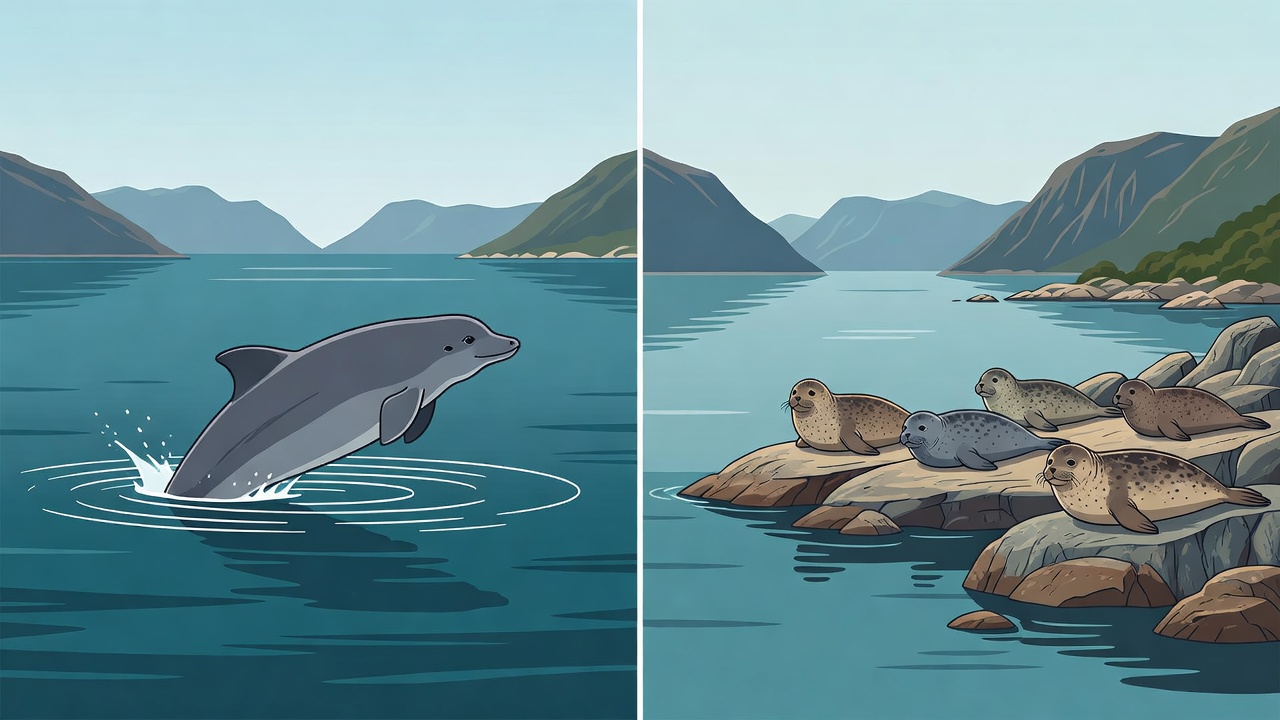
The harbour porpoise, Phocoena phocoena, occurs in many northern coastal waters, including parts of Norway. Its surface appearance is often brief and inconspicuous. You may see a small, dark back and triangular dorsal fin in a rolling movement rather than a dramatic leap or conspicuous blow. Rough water can hide that entire sequence.
Do not treat a single fin shape as conclusive. Distance, viewing angle and the part of the body visible can change an impression. Record the approximate size relative to something known, the number of animals you can actually distinguish, their travel direction and your confidence. Avoid counting every surfacing as a different individual.
Field prompt
Did the movement recur along a consistent route, or did several wave crests happen to resemble a back? Keep both possibilities open.
Read a seal’s use of the shore
Harbour seals and grey seals occur along parts of the northeast Atlantic coast, with local distributions that differ. Both use land or exposed rocks to rest. A haul-out is functional habitat, not an invitation to approach. Resting supports important activities including digestion, moulting and, at particular times and places, reproduction.
Head shape and nostril patterns can assist experienced identification, but they are not always visible from an appropriate distance. Leave the animal unidentified if necessary. Never move closer simply to settle a species question. A seal that raises its head repeatedly, shifts position toward the water or enters the sea may be responding to disturbance. Back away before that sequence develops.
A young seal alone is not automatically abandoned. Adults may be away in the water. Keep people and dogs back, avoid touching or feeding it, and seek advice from the relevant local wildlife authority if there are signs of injury or an immediate threat. Do not attempt a rescue yourself.
Place whales in regional context
Humpback whales and orcas are associated with some Norwegian coastal feeding events, particularly where prey such as herring concentrates. Areas around Kvænangen and Skjervøy are well-known examples of regional whale-watching activity. These are examples, not current sighting reports. The location of prey and animals can change between seasons and years.
A fjord elsewhere should not be expected to host the same animals or timing. Likewise, the presence of feeding birds does not prove that whales are underneath. Birds and mammals may respond to a shared food resource, but a visible association is not enough to identify the prey, its abundance or the animals’ intentions.
Observe without setting the route
From shore, remain on permitted paths and avoid blocking an animal’s access to water. From a vessel, use current local rules and a competent, wildlife-aware operator. Do not intercept travel, surround animals, separate a group or move between adults and young. If animals approach, follow local guidance rather than making sudden changes to obtain another view.
No universal distance on this website replaces regional law. Required separation varies by location and species, and a legal minimum may still be too close for the conditions. Engines, repeated passes and multiple vessels can have cumulative effects even when each observer thinks their own visit is brief.
Keep a record with useful limits
Note the date, approximate time, general area, weather, sea state, estimated group size and observed behaviour. Separate observation from interpretation: “three surfacings moving toward the inlet” is stronger evidence than “a family searching for fish.” Photographs taken without approaching may help specialists, but a photograph is not essential to a worthwhile record.
Use recognized regional reporting channels when a record could contribute to research. For stranded, entangled or distressed animals, contact the appropriate local response organization promptly and follow its instructions. Do not publish a live location that encourages a crowd. The best final entry in a notebook is sometimes simply: watched at a distance, then left.
Reference routes
- Norwegian Polar Institute — species accounts and polar ecosystem context.
- Institute of Marine Research — Norwegian marine science and species information.
- International Whaling Commission — whale conservation and whale-watching guidance.