First read the structure of the coast
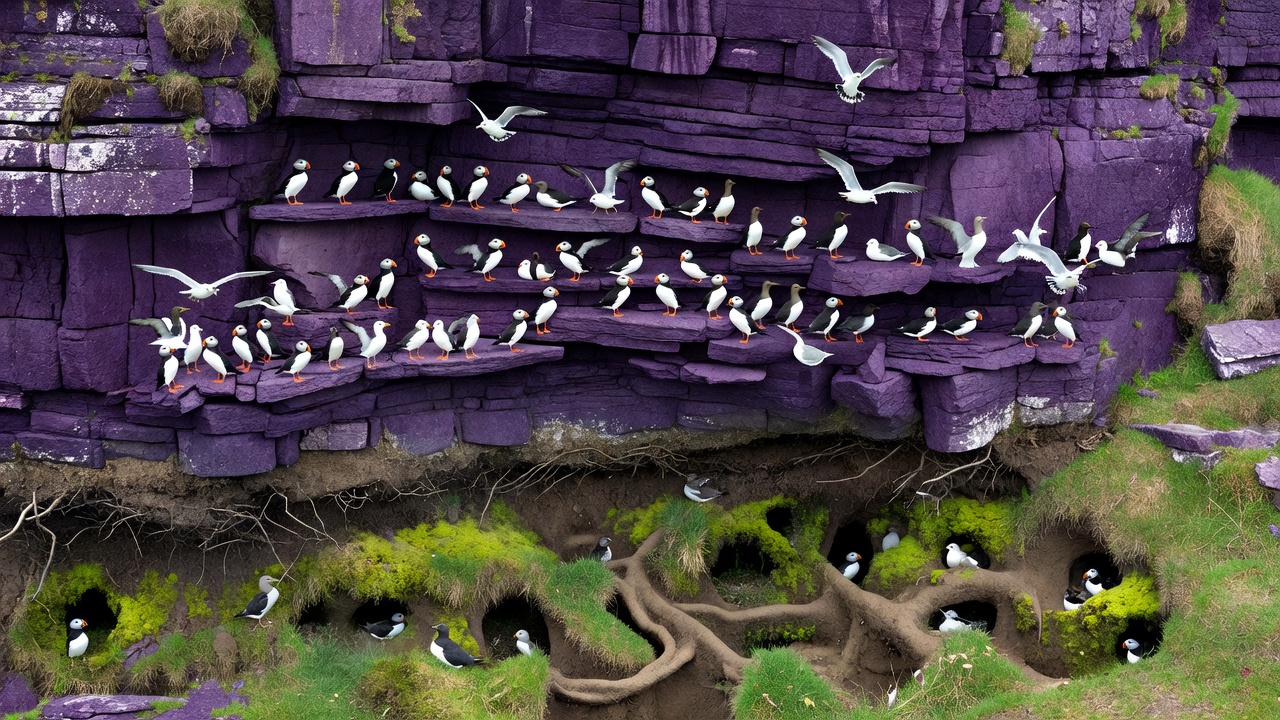
From an established viewpoint, divide the scene into cliff face, grassy top, broken rocks, intertidal shore and open water. These surfaces offer very different nesting and feeding opportunities. A sheer wall may provide narrow ledges, while a vegetated slope can contain burrows that are almost invisible from above. The absence of obvious nests does not make a slope safe to cross.
Then follow the movement between those spaces. Birds arriving along a repeated line may be returning to a colony. Others may pass without landing or circle in rising air. Keep the observation descriptive: a route across the bay is visible evidence; the destination beyond the headland is not. A good field sketch can show more than a hurried species list.
Ledges, burrows and shoreline perches
Black-legged kittiwakes, Rissa tridactyla, commonly nest in colonies on ledges, including natural cliffs and some human structures. Their presence is tied to suitable nesting space and access to marine food, but neither feature alone guarantees a colony. Watch repeated returns to a ledge from a distance rather than approaching to inspect nests.
Atlantic puffins, Fratercula arctica, often breed in burrows or other enclosed spaces on suitable islands and coastal slopes. They are not a standard feature of every inner fjord. Røst and Runde are real Norwegian seabird destinations, but local access restrictions and colony conditions must be checked independently. A well-known bird site is not unrestricted terrain.
European shags and great cormorants can both be encountered along parts of the coast, with distributions and habitat use that overlap imperfectly. A dark bird with spread wings is not enough for a secure identification. Posture, proportions, plumage, location and viewing quality all matter. If the bird is distant, record it as a cormorant-type bird and leave the uncertainty visible.
Field prompt
Which part of the coast does each bird actually use: the ledge, the water, the upper slope or the intertidal edge?
Feeding behaviour reveals a relationship
A group repeatedly diving in one area can indicate a feeding opportunity. Different birds reach food in different ways: some take items near the surface, some plunge from the air and others pursue prey underwater. These methods provide clues about how animals use the water column. They do not identify a fish species by themselves.
Watch the duration of the activity and whether the flock moves with a current feature. Floating seaweed, foam or a colour boundary can help describe the setting, but birds may respond to prey that is invisible to you. Avoid turning a surface scene into a claim about fish abundance. A brief feeding event is a local observation, not a survey of the whole fjord.
Breeding changes the meaning of approach
During nesting, adult birds must balance feeding with protecting eggs or chicks. An observer who causes repeated alarm, circling or departure can interrupt that balance. Some disturbance is less obvious: a bird may remain still rather than flee. Neither silence nor a photograph of a stationary bird proves that your presence is harmless.
Use binoculars, remain on open paths and respect seasonal closures, including restrictions on landing or approaching from the water. Keep dogs under the control required locally and away from breeding areas. Never use sound playback, food, drones or deliberate movement to make a bird look toward a camera or take flight.
Follow the season without forcing a calendar
At many northern colonies, spring and summer bring breeding activity, while birds spend more time away from land outside that period. Exact timing varies among species, latitudes and years. A quiet cliff in autumn is not evidence that its breeding habitat has lost importance. The same space can be seasonally essential even when it appears empty.
Winter observation often shifts toward sheltered water, shore-feeding birds and species present outside the breeding season. Wind, daylight and access may limit what can be observed safely. Compare visits with similar conditions whenever possible. Differences in glare, tide or visibility can change your count without reflecting a biological change.
Make records that do not expose nests
Record the broad area, habitat, approximate numbers, behaviour and your identification confidence. Distinguish birds resting on water from those counted on ledges. A casual count is not a colony census; hidden nests, changing attendance and repeated individuals can all affect the result. If you contribute to a monitoring scheme, follow its method rather than inventing your own totals.
When sharing images, remove precise location information if it could direct people to vulnerable nests or burrows. Report injured birds through suitable local channels and avoid handling them without advice. Watch from a place where the birds can continue their ordinary movements. The most useful insight is often the connection between nesting space and feeding water, not the closest view.
Reference routes
- SEAPOP — Norwegian seabird monitoring and ecological information.
- BirdLife International — bird conservation and species context.
- Norwegian Polar Institute — northern species and ecosystem reference material.